
FSD Beta v11.4 Release Notes
Autopilot Improvements
for Model S, 3, X and Y (Not available in Germany)

– Improved the decision to assert or yield for pedestrians at more crosswalks by evaluating multiple possible futures in the joint space of ego’s actions and the pedestrian’s response.
– Improved ego’s behavior near VRUS by measuring their probability of intersecting ego’s path, based on their kinematic data, and preemptively decelerating when the estimated risk is high.
– Improved turn performance in dense unstructured city environments. Examples of improved cases include: turning when the turn lane is blocked by parked cars and avoiding turning into bus lanes.
– Improved lane guidance module to feed in long range routing “hints” to the network for which lanes ego needs to be in to reach its destination. Also significantly improved per-lane routing type autolabeler. These changes combined resolved 64% of all interventions caused by bad routing type.
– Improved geometric consistency between lane, line, road edge and restricted space detections by re-training our networks on the same dataset with the latest version of our “lane guidance” module, and by using a common features space to predict line, road edge and restricted space.
– Improved recall for partial cut-ins by 39% and precision for false positive cut-ins due to lane changes into adjacent lanes by 66%, resulting in a 33% reduction in overall lane-changing prediction error. This was accomplished by further increasing our auto-labeled fleet dataset by 80k clips, improving the accuracy of the auto-labeling algorithm, and tuning the distribution of training supervision.
– Improved understanding for when to use bus lanes and when to avoid them, by updating the lane type detection network and improving map- vision fusion.
– Improved speed control during lane changes through better consideration of upcoming navigation deadlines, required back-to- back lane changes and presence of a vehicle behind ego.
– Added new Vision Speed network to infer the typical driving speed on a given road. This is used to limit the maximum allowed speed in environments such as parking lots and residential roads.
– Mitigated hydroplaning risk by making maximum allowable speed in Autopilot proportional to the severity of the detected road conditions. In extreme cases, Autopilot may use the wetness of the road, tire spray from other vehicles, rain intensity, tire wear estimation or other risk factors that indicate the vehicle is near the handling limit of the surface to warn the driver and reduce speed.
– Improved long-range path blockage detection and control on city streets. Ego will now be able to perform lane changes due to upcoming path blockages earlier.
– Improved developer productivity with better code diagnostics and C+ +20 features by upgrading compiler to clang-16. This also improved photon-to-control vehicle response latency by 2%.
Full Self-Driving (Beta) Suspension
Autopilot Improvements
for Model S, 3, X and Y (Not available in Germany)

For maximum safety and accountability, use of Full Self-Driving (Beta) will be suspended if improper usage is detected. Improper usage is when you, or another driver of your vehicle, receive five ‘Forced Autopilot Disengagements’. A disengagement is when the Autopilot system disengages for the remainder of a trip after the driver receives several audio and visual warnings for inattentiveness. Driver-initiated disengagements do not count as improper usage and are expected from the driver. Keep your hands on the wheel and remain attentive at all times. Use of any hand-held devices while using Autopilot is not allowed.
The FSD Beta feature can only be removed per this suspension method and it will be unavailable for approximately two weeks.
Park Assist
New Feature
for Model 3 and Y

Tesla Vision Park Assist provides visual and audio alerts of surrounding objects. This feature uses the occupancy network to predict high-definition outlines of objects 360 degrees around the car.
Note: Tesla Vision Park Assist is for guidance purposes only and is not a substitute for an aware driver. Please be attentive and avoid obstacles as required.
Over-the-Air (OTA) Recall
New Feature
for Model S, 3, X and Y (Not available in Germany)

In accordance with a recent recall (campaign #23V085 for US and #2023-063 for Canada), Tesla is making improvements to the following specific behaviors within FSD Beta:
1. Improved decision logic to proceed through or stop at certain yellow lights by modeling the decision as a tradeoff framework that considers estimated: deceleration required to stop, time to enter and exit the intersection, and the distance traversed across the intersection before the light transitions to red. This should make yellow light handling more natural and human-like.
2. Improved the longitudinal slowdown control profile when leading up to stop sign intersections to make the overall maneuver feel more perceptible and natural.
3. Improved the Tesla’s speed adjustment when entering certain speed zones by allowing for earlier control for detected speed limit signs. The assertiveness of the response when slowing down for detected speed limit signs is determined by the current speed and its difference to the speed indicated by the detected sign. Added a visual glow behind the speed limit icon on the user-interface to alert the driver when the vehicle’s set speed exceeds the detected speed limit by more than 50%. Finally, the option for an absolute Speed Limit offset in FSD Beta was removed; only the percent-based offset will be available.
4. Updated the behavior for certain scenarios where the Tesla may maneuver from a turn lane to continue traveling straight. These maneuvers will now be treated as a lane change, where the turn indicator is used to alert other drivers of the Tesla’s intent.
As a reminder, the driver is responsible for vehicle operation even when FSD Beta is engaged. You must constantly supervise the road, keep your hands on the wheel and be ready to intervene to maintain safety.
Full Self-Driving (Beta)
Autopilot Improvements
for Model S, 3, X and Y (Not available in Germany)
You can enable Full Self-Driving (Beta) by tapping ‘Control’ > ‘Autopilot’ > ‘Full Self-Driving (Beta)’ and following the instructions.
Full Self-Driving is in early limited access Beta and must be used with additional caution. It may do the wrong thing at the worst time, so you must always keep your hands on the wheel and pay extra attention to the road. Do not become complacent. When Full Self-Driving is enabled your vehicle will make lane changes off highway, select forks to follow your navigation route, navigate around other vehicles and objects, and make left and right turns. Use Full Self-Driving in limited Beta only if you will pay constant attention to the road, and be prepared to act immediately, especially around blind corners, crossing intersections, and in narrow driving situations.
Your vehicle is running on Tesla Vision! Note that Tesla Vision also includes some temporary limitations, follow distance is limited to 2-7 and Autopilot top speed is 85 mph.
Driving Visualization Improvements
Autopilot Improvements
for Model S, 3, X and Y (Not available in Germany)
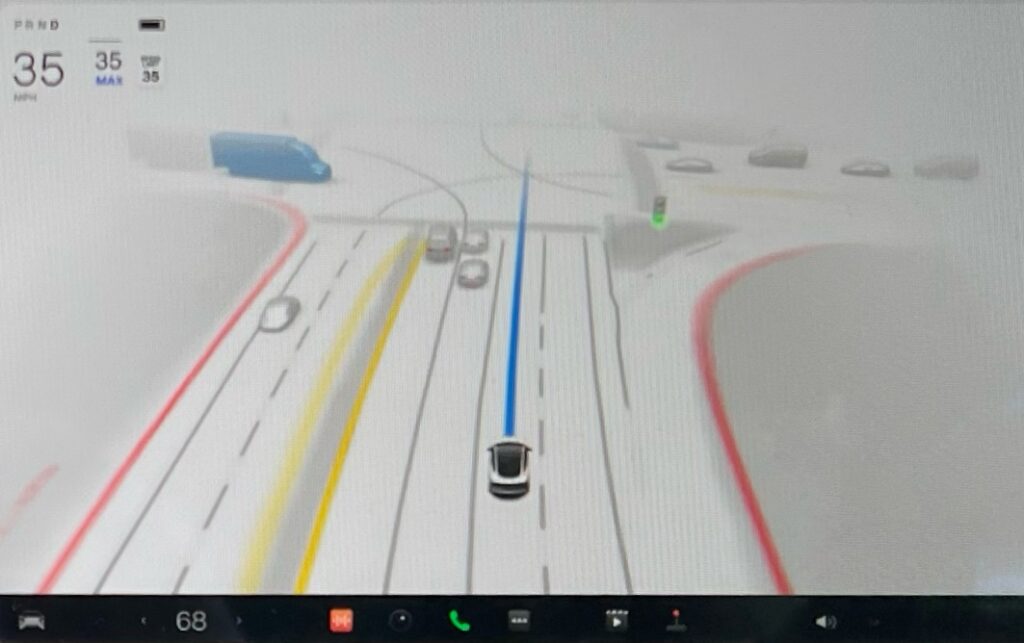
To view an expanded driving visualization when in drive with Full Self-Driving enabled, drag the light gray visualization bar to the right.
)