

Tesla software update 2026.33.5, dated October 7, 2026, combines home backup power support with changes to supervised driving. Its four documented entries cover Vehicle-to-Home with Powerwall, Automatic Collision Evasion, FSD (Supervised) v14.3.11, and the general Full Self-Driving operating guidance. The notes label each entry New Feature, although the FSD description also carries forward improvements introduced in earlier versions.
For Cybertruck owners with the necessary equipment, Vehicle-to-Home with Powerwall lets the vehicle battery help extend home backup power during an outage. The vehicle must be parked, connected to a compatible Wall Connector, and have more charge than the configured discharge limit. Powerwall is required, and the function is enabled through Charging > Powershare. These conditions matter because the feature depends on the home charging and backup installation as well as the vehicle.
Automatic Collision Evasion is listed for HW4-equipped newer Model S and Model X, Model 3, Model Y, and Cybertruck. It can activate FSD (Supervised) during manual driving when insufficient attention or a potentially unintended disengagement is detected, attempting to keep the vehicle safe and continue driving. Drivers should consult their vehicle manual for the operating details; this function does not remove the need to remain attentive.
FSD v14.3.11 focuses on perception, decision-making, and responsiveness. The description covers reinforcement-learning changes, better interpretation of difficult visibility and road geometry, broader sign recognition, and a rewritten AI compiler and runtime associated with a stated 20% improvement in reaction time. Other areas include lane positioning, following distance, parking decisions, emergency vehicles, school buses, animals, complex traffic lights, and unusual obstacles.
The driving notes also describe recovery from temporary system degradation and refinements to driver monitoring. Carried-forward additions include intervention feedback, intervention-free distance tracking, destination parking options, and model sharing across FSD, Actually Smart Summon, and Robotaxi. The higher Actually Smart Summon speed has a specific Cybertruck exclusion. Expanded reasoning and pothole avoidance remain upcoming improvements rather than confirmed additions in this release.
The illustrated 2026.33.5 Release Notes below explain each entry, its vehicle and hardware requirements, and how to activate the supported functions. Full Self-Driving remains supervised: the driver must stay alert and ready to take over.
Vehicle-to-Home with Powerwall
New Feature
for CT
Powerwall / Compatible Wall Connector / Parked and plugged in / Charge above configured discharge limit
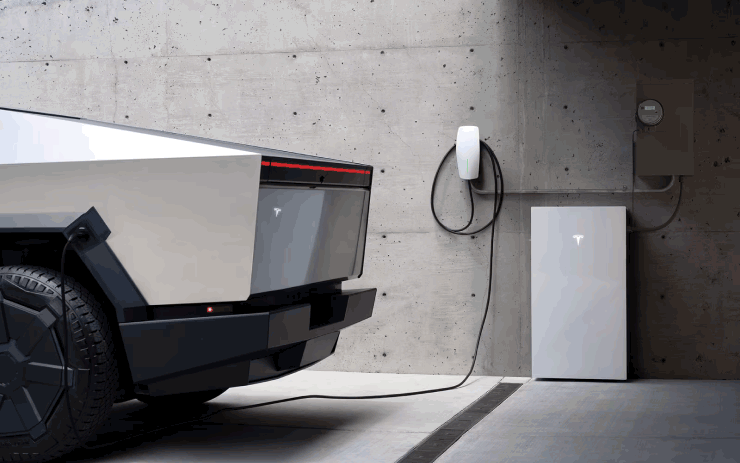
A compatible Cybertruck can supplement a Powerwall-backed home during a power outage, using energy from its vehicle battery to extend the backup supply. Enable the function in Charging > Powershare.
Operation requires Powerwall and a compatible Wall Connector. The vehicle must remain parked and plugged in, with battery charge above the discharge limit you have selected.
Automatic Collision Evasion
New Feature
for Model S (New), 3, X (New), Y and CT
HW4

Automatic Collision Evasion can activate FSD (Supervised) while the vehicle is being driven manually if it detects insufficient driver attention or a possible accidental FSD disengagement. Its purpose is to attempt a safe response and continue driving. The listed vehicles require HW4; consult the Owner's Manual for the detailed operating conditions.
FSD (Supervised) v14.3.11
New Feature
for Model S (New), 3, X (New), Y and CT
HW4
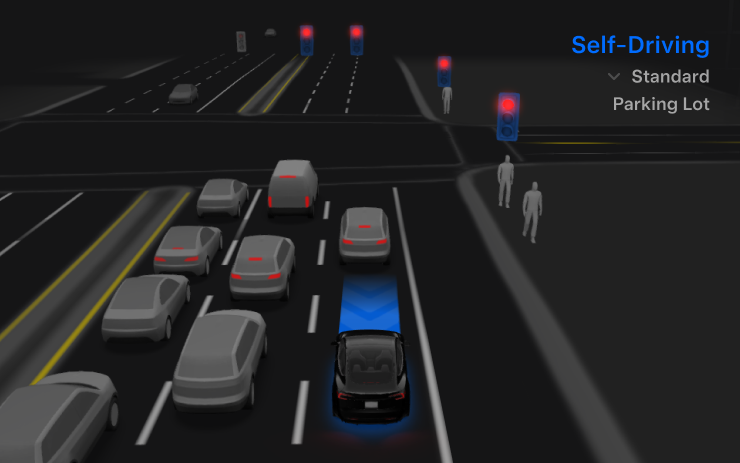
The v14.3.11 description includes improvements to reinforcement-learning training and the vision encoder, covering difficult visibility, rare situations, three-dimensional road geometry, and traffic signs. A rebuilt AI compiler and runtime using MLIR is associated with a stated 20% improvement in reaction time and faster model iteration.
Driving refinements address unwanted lane bias and close following, make parking selection and maneuvering more decisive, and improve the predicted parking pin shown with a P icon. Responses to emergency vehicles, school buses, right-of-way violations, and unusual vehicles are also covered.
Additional training targets small animals, complicated traffic signals, curved approaches and yellow-light stopping, along with uncommon objects that project into the driving path. Temporary system degradation can be handled with continued control and automatic recovery to reduce unnecessary disengagements. Driver monitoring gains better gaze tracking, eyewear handling, and accuracy across lighting conditions.
The notes retain the shared model across Actually Smart Summon, FSD, and Robotaxi, introduced in v14.3.2 for vehicles other than Cybertruck and in v14.3.4 for Cybertruck. Actually Smart Summon's 8 mph (13 km/h) maximum, added in v14.3.3, is excluded on Cybertruck. Earlier additions also include choosing an intervention reason after taking over (v14.3.2), viewing intervention-free distance and the longest streak (v14.3.3), and showing destination parking options on the map (v14.3.4).
The roadmap still lists broader reasoning beyond destination handling and pothole avoidance as upcoming improvements. They are not presented as available features of v14.3.11.
Full Self-Driving (Supervised)
New Feature
for Model S (New), 3, X (New), Y and CT
HW4
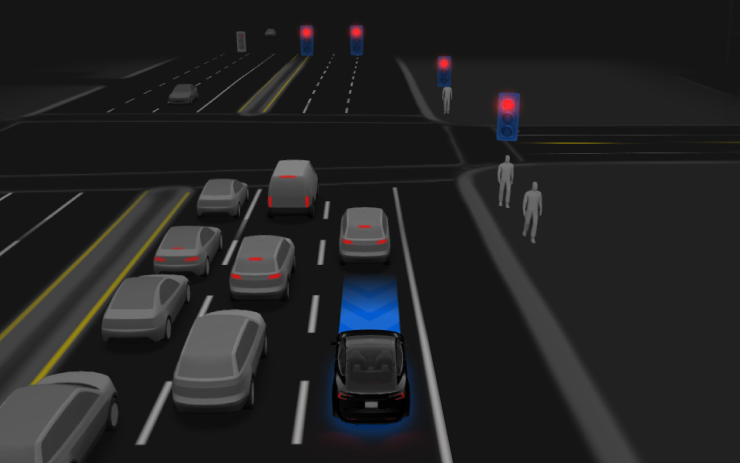
With continuous driver supervision, FSD can start from a parked position, follow navigation through lane changes and junctions, maneuver around traffic and objects, make turns, and park at the destination. It does not make the vehicle autonomous; every authorized driver must remain attentive and prepared to intervene.
Start the feature using the on-screen Start Self-Driving control or a single press of the right scroll-wheel button. It can be disabled in Autopilot Settings.
